A school for leaders who want change

Learn first

KMBS latest news in real time
For the latest KMBS events and news, visit KMBS Live at the top right corner of the screen

Open kmbs live
Home
/
Programs
/
Executive Development Programs
/
Strategy
/
Territorial Communities and Education Leaders: A Strategy for a Holistic, Child-Centered System of Personal Development
dates of programs start
30/4/2026
Format
7 modules 3 days each
offline
cost
850,000 per team / 180,000 per individual participant uah
Territorial Communities and Education Leaders: A Strategy for a Holistic, Child-Centered System of Personal Development
A comprehensive program for territorial communities that view education as the core of national development and seek to integrate fragmented institutions, policies, and practices into a holistic, child-centered system.
The program is designed for management teams of territorial communities (5–6 members), which include:
Community leaders (heads and deputy heads responsible for social and humanitarian affairs) who shape policies, influence decision-making, and allocate resources.
Education leaders (heads of departments of education, schools, cultural and sports institutions, social services, and libraries) who are directly responsible for developing the community’s education and cultural system.
Education practitioners (teachers, staff of inclusive resource centers, and professional development centers for educators) who implement change directly at the level of educational practice.
The program will also be valuable for representatives of national institutions — such as the State Service of Education Quality of Ukraine (SSEQ), the Ukrainian Institute of Education Development (UIED), the Ukrainian Center for Educational Quality Assessment (UCEQA), and others — as well as for donors, international partners, educational clusters, and other stakeholders.
Upon completion of the program, participants will be able to:
To design a coherent architecture for the community’s education system — one that positions education as the core driver of development and aligns decisions across institutions around a child-centered logic.
To create new formats of interaction within the educational ecosystem — initiatives, programs, and practices that support the development of children and youth in the community.
To strengthen community engagement — involving parents, young people, educators, local businesses, and civil society organizations in the co-creation of educational solutions and initiatives.
To develop management decisions and mechanisms that support long-term human development and strengthen the community’s capacity to grow its human capital.
The structure of the program
Module 1
Strategic Perspective of Leaders in Territorial Communities

In this module, participants will begin by adopting a strategic perspective — one that allows them to see the education system not as a set of disconnected institutions, but as a space where the future of the community is shaped.

They will learn to distinguish between strategic, tactical, and operational decisions, and will reframe strategy not as a formal document but as a logic of change. At the heart of this exploration lies the role of educational institutions as active agents of development — institutions that contribute to community well-being and shape a distinctive local learning ecosystem.

Participants will define the boundaries of their own decision-making, responsibility, and resources. Working through meaning-centered task-setting will enable them to act coherently across diverse contexts and focus on real levers of impact. They will also reflect on the roles of leaders and teams, as well as their own strengths.

A key focus of the module is understanding the purpose behind the community's education system: the development of the child — as a person and as a citizen.

Module 2
The Education System of a Territorial Community Through the Lens of Child-Centered Development

In this module, participants work with the concept of education as an open system — one that functions within the context of the territorial community and broader social dynamics. They examine their own leadership roles and how these roles influence the system’s architecture: the connections between key stakeholders, the logic of interaction, and the direction of development — rather than isolated events or decisions.

A key element of the module is the development of the system’s “DNA” — a strategic idea that integrates vision, values, and mission, setting a coherent logic for the evolution of the educational environment.

The second focus of the module is mission-driven governance, where the child and their development become the point of alignment for the entire community education system. Participants explore youth as a form of strategic capital for the community.

Special attention is devoted to the role of space, aesthetic intelligence, and visual culture. Using the Samchykivka folk painting tradition as an example, participants will reflect on the factors that shape local identity.

Module 3
Educational Systems of Volyn’s Territorial Communities: Governance Models and Practices (Field Module in Lutsk)

Through the lens of the Lutsk territorial community and the Volyn region more broadly, participants will explore how historical, economic, and spatial contexts intersect within the development strategy of a specific community. They will analyze how priorities across different governance levels are aligned, and what role education plays in the overall logic of territorial development.

Examples of collaboration with businesses, universities, and cultural institutions will highlight education as part of a broader network of partnerships that generate value for the community.

Participants will also examine education as a community’s investment in the development of human capital. Drawing on examples of communities that successfully operate within this logic, they will observe how governance decisions influence the attraction of young people, families, and resources.

Module 4
Vision for the Development of Education in the Territorial Community: A New Model of the Community Education System

In this module, participants move toward a holistic vision of the education system in their territorial community. They explore how individual decisions, initiatives, and roles are interconnected. Instead of taking fragmented steps, teams will develop a shared understanding of community education development — one that can serve as a foundation for future governance decisions.

Participants will learn to identify the current management logic behind their local education system: where it reproduces familiar approaches, and where change is needed. They will practice formulating a vision for the development of education in the territorial community, aligning the actions of different institutions, and determining which approaches work in their context — and which do not.

Module 5
Management Processes and System Modeling in Territorial Community Education

In this module, participants will shift from administering functions to designing processes — seen as value-creation chains where every management decision contributes to the quality of life in the community. They will learn to view the education system not as a collection of institutions, but as an integrated whole — where arts, sports, and library spaces act as drivers of youth development and social cohesion.

Throughout the module, participants will distinguish between functions, projects, and processes, and practice describing the key governance processes that shape the local education system.

Module 6
New Approaches to the Role of Education Leaders in Territorial Communities

This module offers a shift in how education quality is governed — from control and comparison toward development and support. Through examples of alternative assessment models, participants will rethink the logic of feedback in schools and its influence on relationships between students, parents, and educators.

A key focus is understanding team roles and the varying levels of maturity people bring to those roles. Participants will also revisit the role of the teacher — not simply as a transmitter of knowledge, but as a key actor who shapes the educational environment and supports students’ individual learning journeys.

Drawing on practices of civic education, the school is reimagined as a space of responsibility, participation, and collaboration. The module also explores financial autonomy of educational institutions and partnerships focused on the long-term development of the territorial community.

Module 7
Final Module

In the final stage of the program, participants work with the education system models of their own territorial communities, examining how decisions made at different levels align and interact. Within this context, the exploration of artificial intelligence serves as a prompt to rethink governance processes and uncover new opportunities for strengthening team collaboration and decision-making.

The module culminates in project presentations. Each team presents its own model, receives feedback, and articulates key conclusions related to building a holistic, child-centered system for personal development.

As part of their final projects, participants are expected to develop:

  • a youth development strategy for their territorial community;
  • a design for a holistic, child-centered model of personal development using client-centered methodology;
  • an operational model for an educational institution within the community;
  • and descriptions of role transformations within the envisioned educational institution.

Faculty
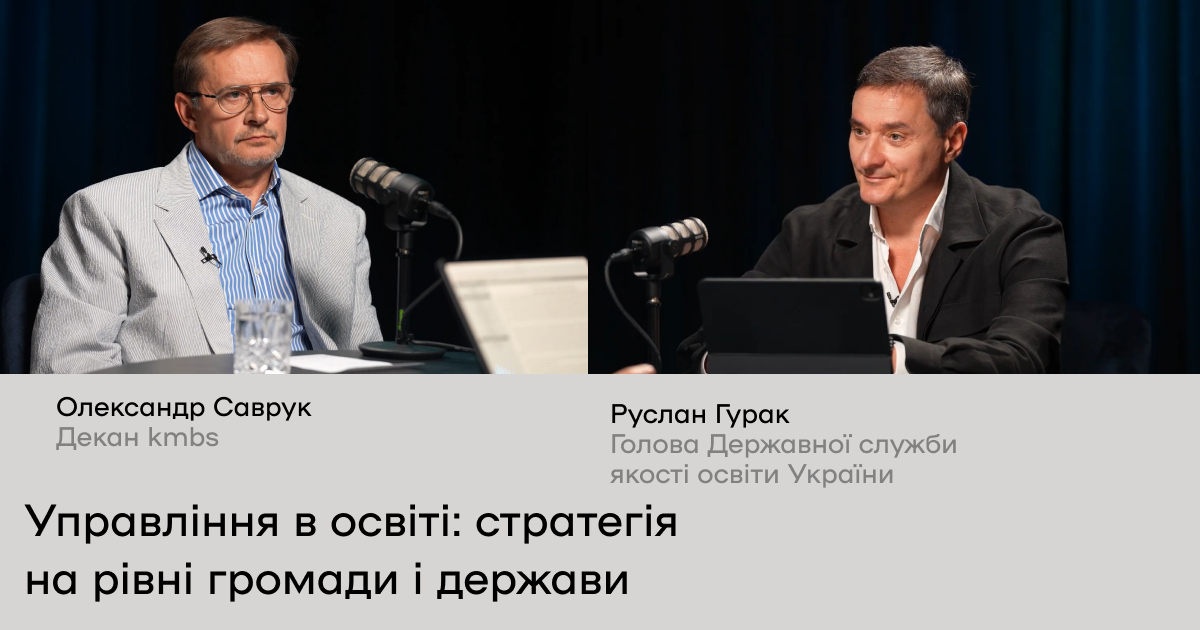
Oleksandr Savruk more details
Dean
Руслан Гурак more details
Генадій Зубко more details
Лілія Гриневич more details
Тетяна Вакуленко more details
Валентина Топольніцька more details
Kateryna Molodecka more details
Olga Shcherbyna more details
CORE
Sergiy Nozdrachov more details
Adjunct professor
Participation in the program
1.
Application form
fill out the online application form
2.
Communication
talk to the manager about the request for training and expectations from it
3.
Interview
pass an interview with the program author
4.
Participation confirmation
to reserve a spot in the group, a prepayment of the program cost is required.
cost
850,000 per team / 180,000 per individual participant uah
Apply for the program
For more information about the program, please contact
Daryna Symych
EDP program manager
kmbs live
19.03.2026 at 12:30
Системне мислення управлінця: розуміння себе, команди і компанії як системи ...
23.12.2025 at 16:45
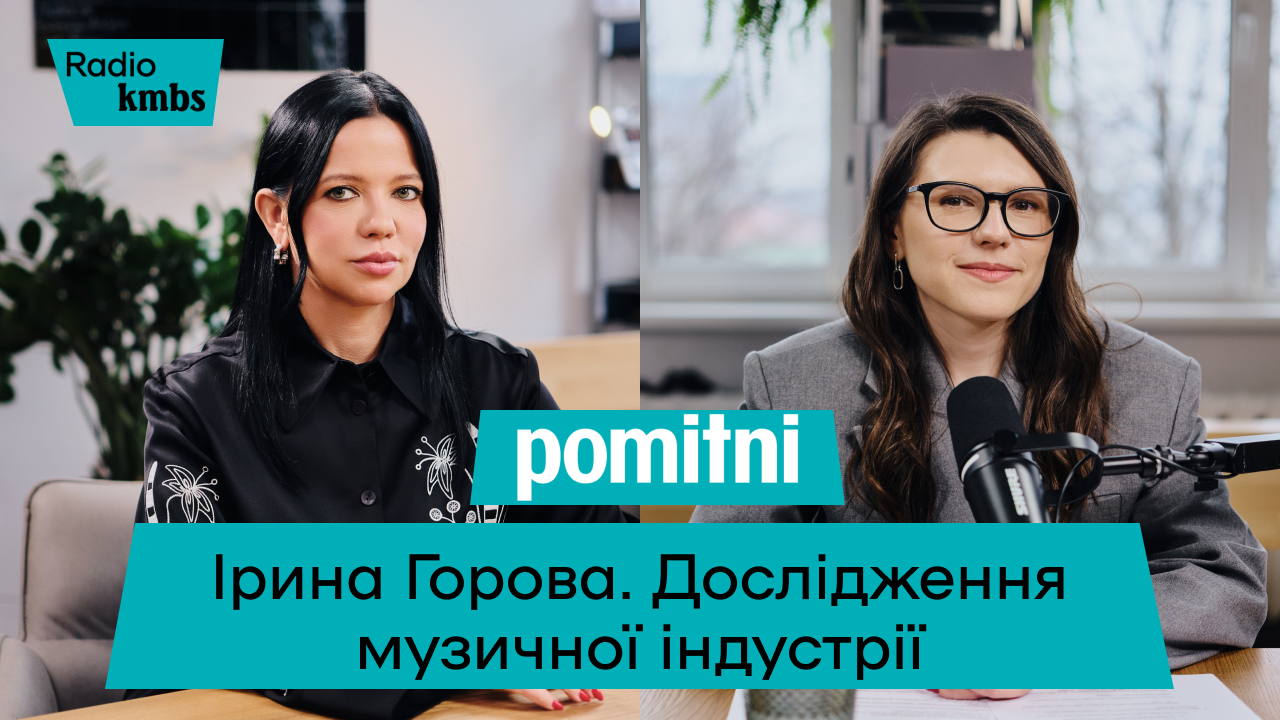
Ірина Горова. pomitni: трансформація лейблу, дослідження музичної індустрії, створення асоціації ...
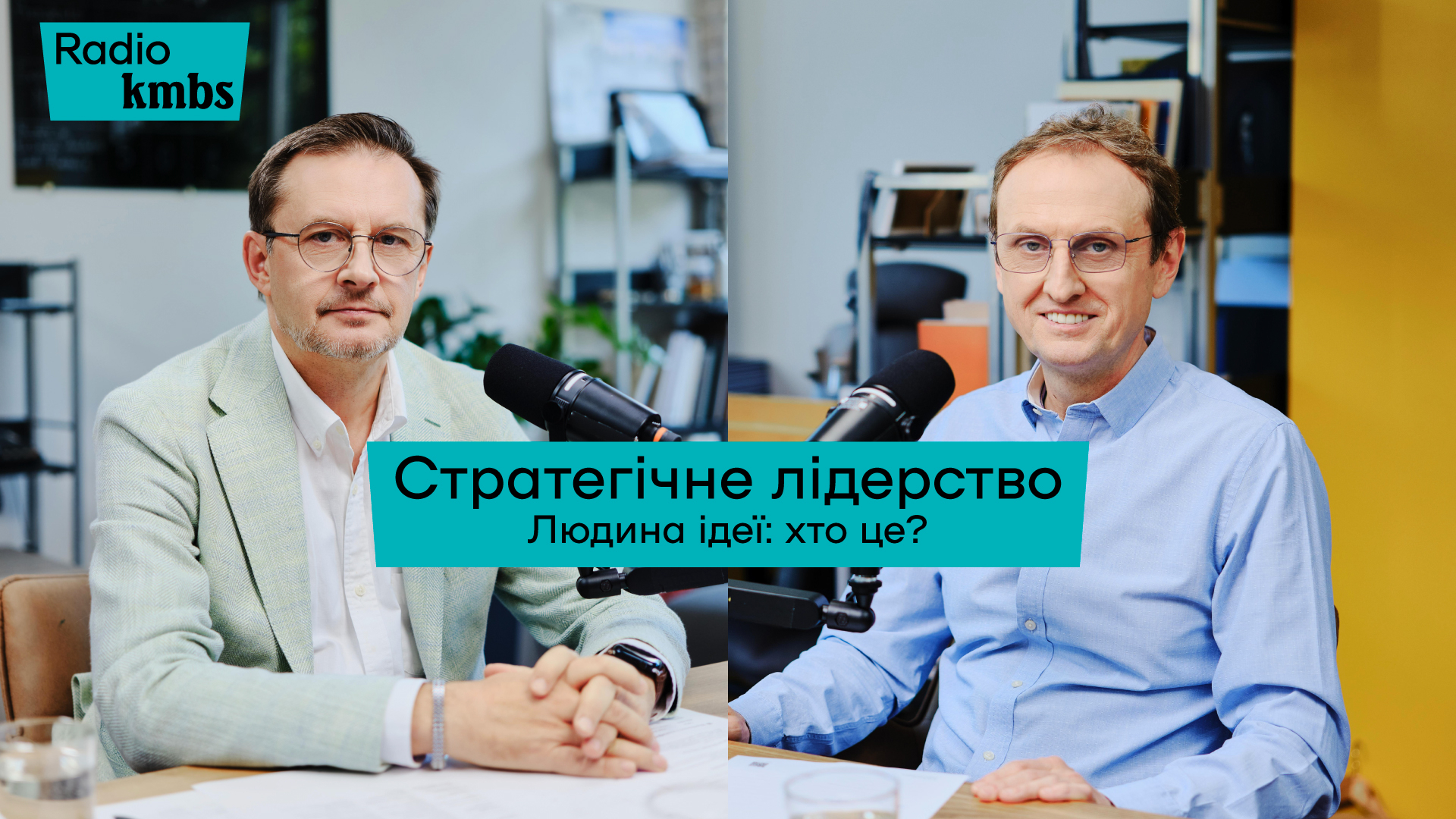
25.09.2025 at 18:00
Стратегічне лідерство ...
26.07.2025 at 17:00
Netpeak Group: Артем Бородатюк про побудову бізнесів та реалізацію ідей ...
08.07.2025 at 10:00
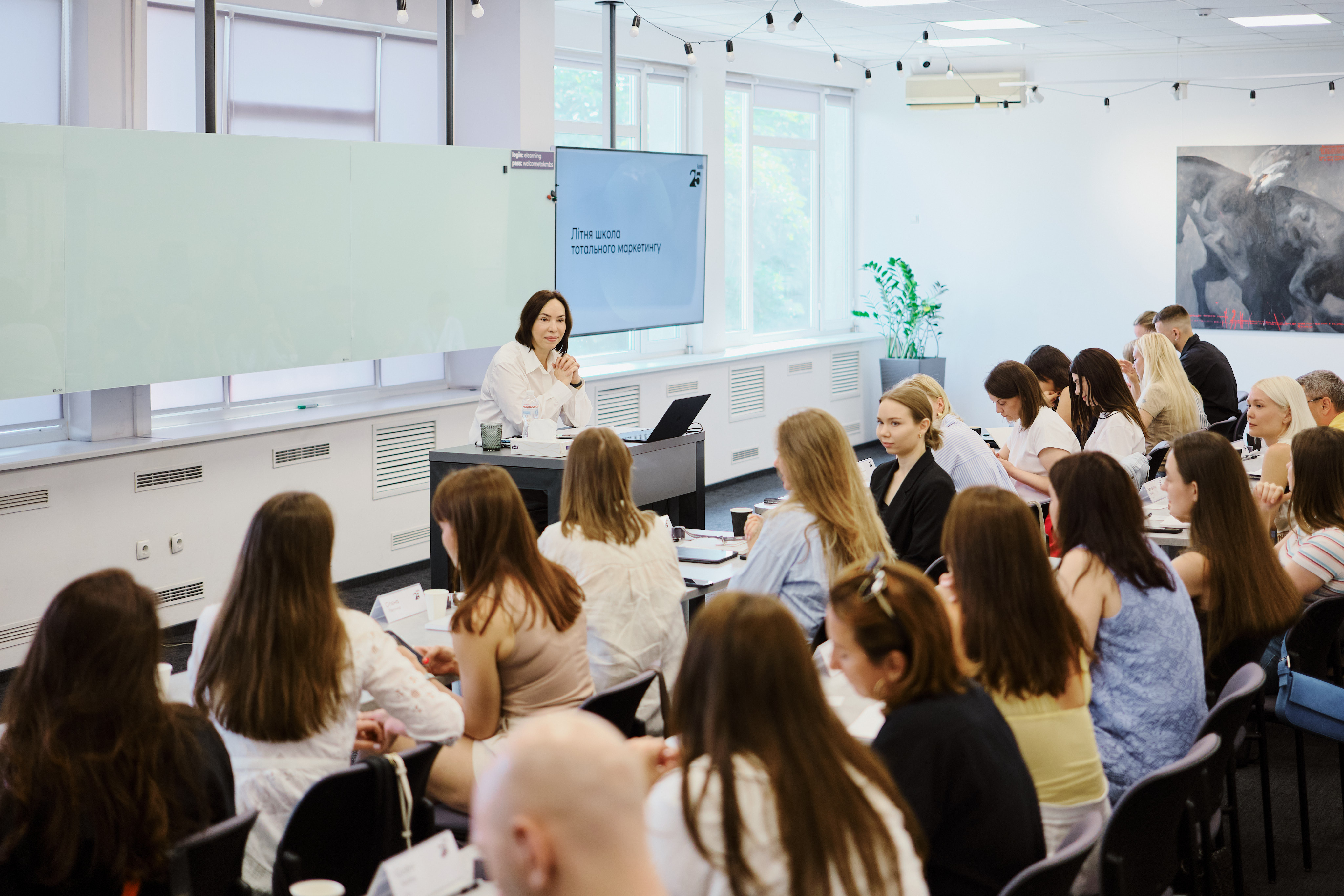
25-й старт “Літньої школи тотального маркетингу” ...
26.06.2025 at 18:00
"Роль CEO: Андрій Тертишник. Кейс fint8" ...
12.06.2025 at 16:20
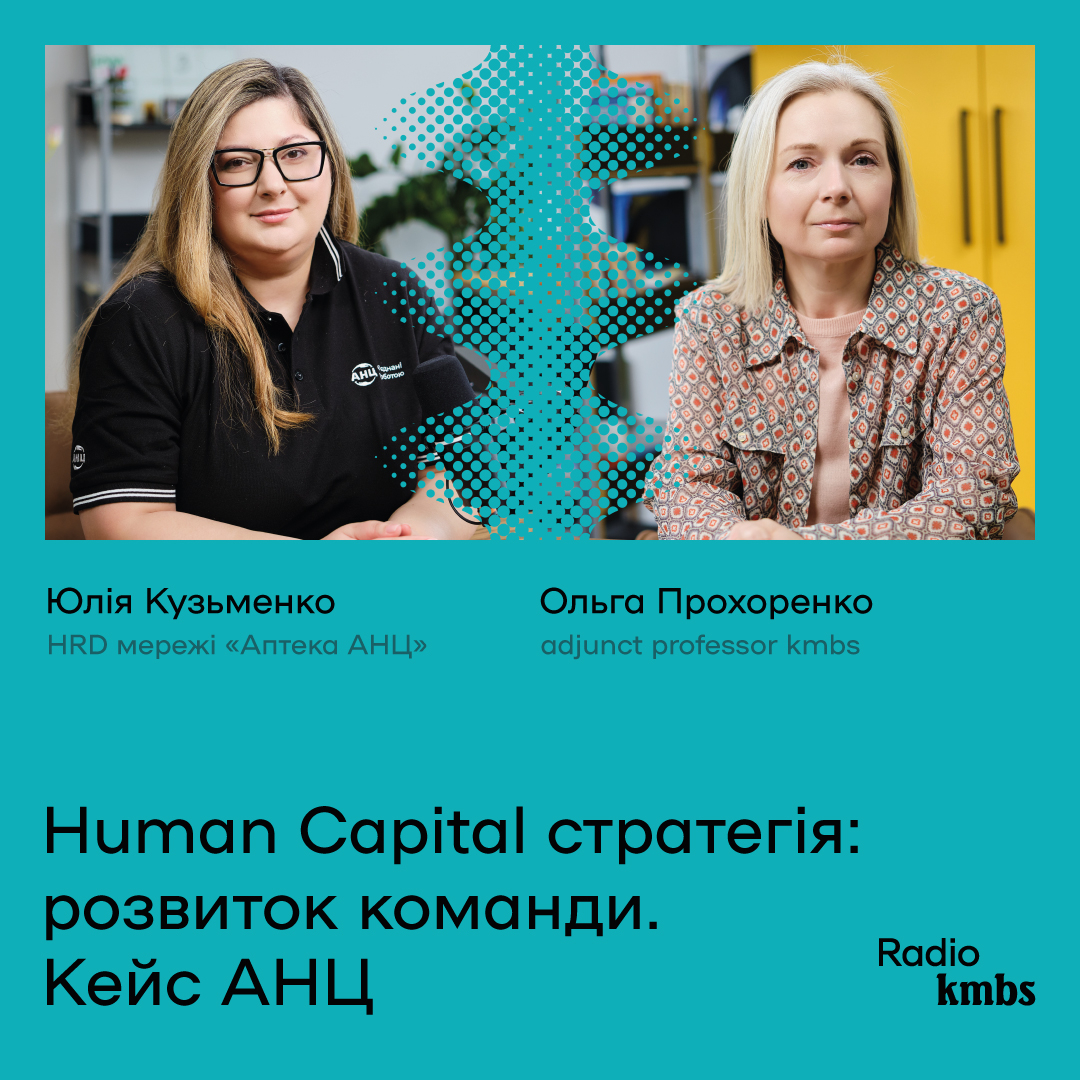
Human Capital стратегія: розвиток команди. Кейс АНЦ ...
29.05.2025 at 17:00
Створення інакшості: українське кіно ...