A school for leaders who want change

Learn first

KMBS latest news in real time

For the latest KMBS events and news, visit KMBS Live at the top right corner of the screen

Open kmbs live
Home
/
Programs
/
Executive Development Programs
/
Management
/
Project management: moving to a higher level of complexity
dates of programs start
18/6/2026
Format
2 modules, 3 days each
10:00 - 18:00
cost
60000 uah
Project management: moving to a higher level of complexity
A program focused on the key leverage points in complex projects.
For project managers, project leads, and department heads who:
have delivered multiple projects and are seeking leverage points to achieve significantly higher-quality results
run several projects simultaneously and want to establish robust operational management in their teams while maintaining a strategic, top-down view of each project
we are accountable for project delivery in their domain and must continually balance operational responsibilities with project work
we are moving on to more complex projects and want to prepare for them.
Participants will be able to:
Understand the strategic context of the project to ensure its goals are aligned with business objectives
Identify the needs of the client/customer and other stakeholders, shape a clear vision of the result, and communicate it to the team
Design the project governance architecture—work with the logic of interconnections among components, see the critical details that influence progress and outcomes, and make decisions with the integrity of the project in mind
Balance the constraints of the project triangle—time, cost, and scope. Dynamically manage changes in one parameter by appropriately adjusting the others to maintain project quality
Build the project team and create the best possible alignment between people in roles and the project’s desired outcomes
Establish trust in the project environment as a prerequisite for productive team performance
The structure of the program
Module 1
Project Design
18–20 June

  • Understanding the essence of project management and how it differs from ongoing operations. An introduction to foundational concepts—including the “project triangle” (the trade-offs among time, budget, and scope) and the Cone of Uncertainty, which describes how uncertainty around scope, cost, and duration evolves over the project life cycle;
  • “Deep Dive” case: evaluating management via a virtual project audit;
  • Challenges for the project leader: balancing soft and hard skills, analyzing common issues, and developing strategies to address them;
  • Working with the client: techniques for eliciting stakeholder needs and translating them into a clear requirements specification with an accurate scope of work;
  • Practical case analysis: identifying problem areas, formulating hypotheses, and designing systemic solutions for similar situations;
  • Project planning tools: building Gantt charts, determining the critical path, and best practices for visualizing and communicating variances from the plan;
  • Principles of building and leading project teams: the leader’s role, selection strategies, effective meetings, and group dynamics;
  • Designing the project’s organizational structure: role structures, team boundaries, role deliverables, and interaction among team members at different project stages;
  • Project budgeting: specifics of planning, control, and communicating variances; analysis of real budgets and schedules to develop practical skills.

Module 2.
Implementation
16–18 July

  • Project risk management: methods for identification, assessment, and development of response strategies for systemic factors and anomalies;
  • Project reporting: structures and purposes for different audiences, levels of detail, update approaches/cadences, and methods to ensure transparency;
  • Practical project control tools: progress tracking, change management, and principles of data-driven decision-making;
  • Earned Value Management (EVM): calculation and interpretation of schedule and cost performance indicators;
  • Cynefin Framework: classifying problems and selecting decision-making approaches appropriate to the context;
  • Agile project management methodologies: Agile, Scrum, Kanban—principles, use cases, benefits, and limitations across different project types;
  • Practical simulation of project management components: group case work to integrate acquired knowledge and skills;
  • Systems analysis of project decisions: identifying interdependencies among different aspects of the project and developing integrated management approaches.

Faculty
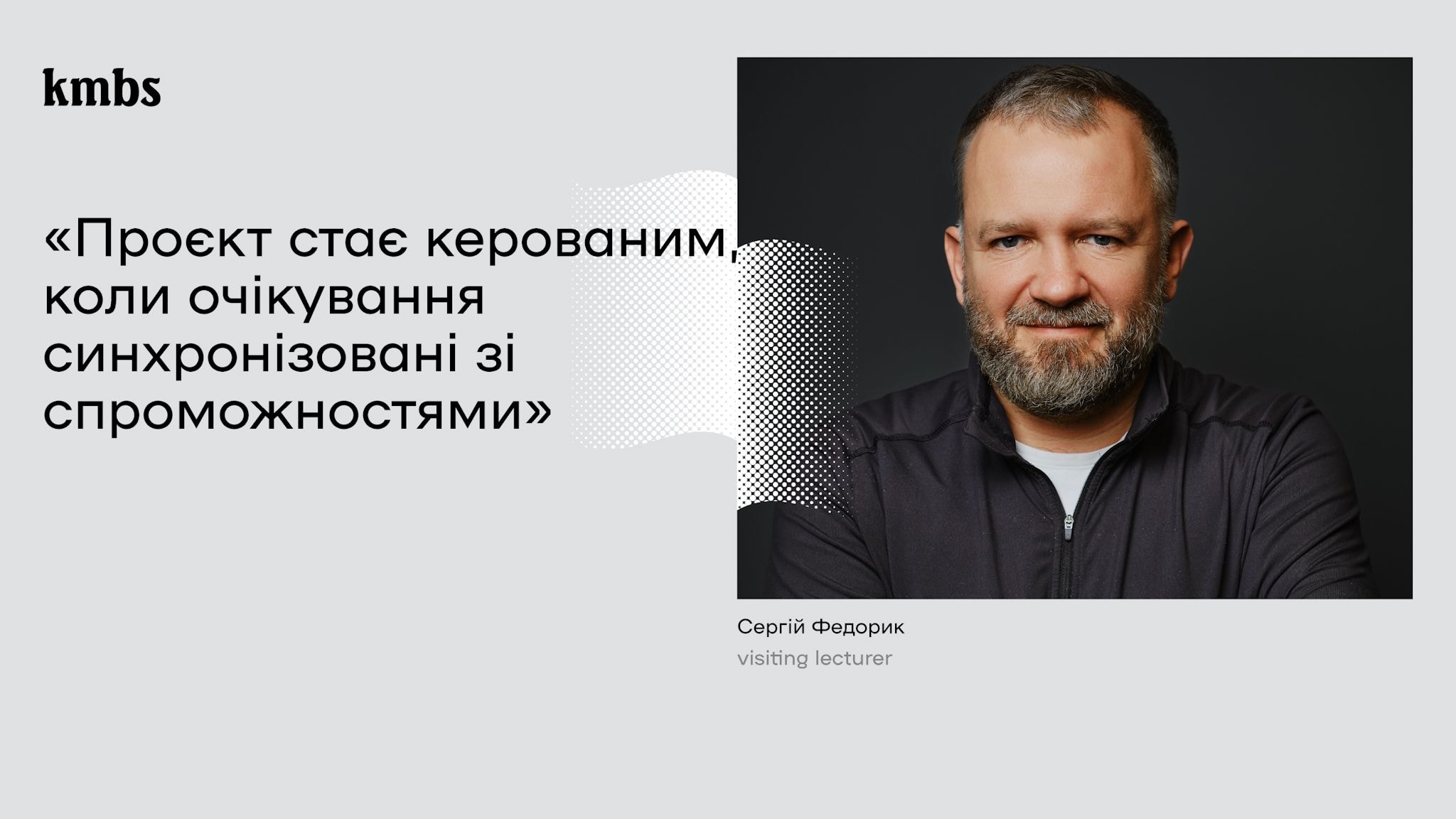
Serhiiy Fedoryk more details
Olga Shcherbyna more details
CORE
Artem Bukovets more details
Adjunct professor
Tymur Demchuk more details
Adjunct professor
What do you need to attend?
1.
Application form
fill out the online application form
2.
Communication
speak with the Program Manager
3.
Confirmation of participation
reservation of a place in the group takes place after payment
cost
60000 uah
Apply for the program
For more information about the program, please contact
Denis Pavlivskiy
EDP program manager
kmbs live
19.03.2026 at 12:30
Системне мислення управлінця: розуміння себе, команди і компанії як системи ...
23.12.2025 at 16:45
Ірина Горова. pomitni: трансформація лейблу, дослідження музичної індустрії, створення асоціації ...
25.09.2025 at 18:00
Стратегічне лідерство ...
26.07.2025 at 17:00
Netpeak Group: Артем Бородатюк про побудову бізнесів та реалізацію ідей ...
08.07.2025 at 10:00
25-й старт “Літньої школи тотального маркетингу” ...
26.06.2025 at 18:00
"Роль CEO: Андрій Тертишник. Кейс fint8" ...
12.06.2025 at 16:20
Human Capital стратегія: розвиток команди. Кейс АНЦ ...
29.05.2025 at 17:00
Створення інакшості: українське кіно ...