Learn first
KMBS latest news in real time
For the latest KMBS events and news, visit KMBS Live at the top right corner of the screen
Open kmbs live 10.03.2026
 1894
1894 6min
6min


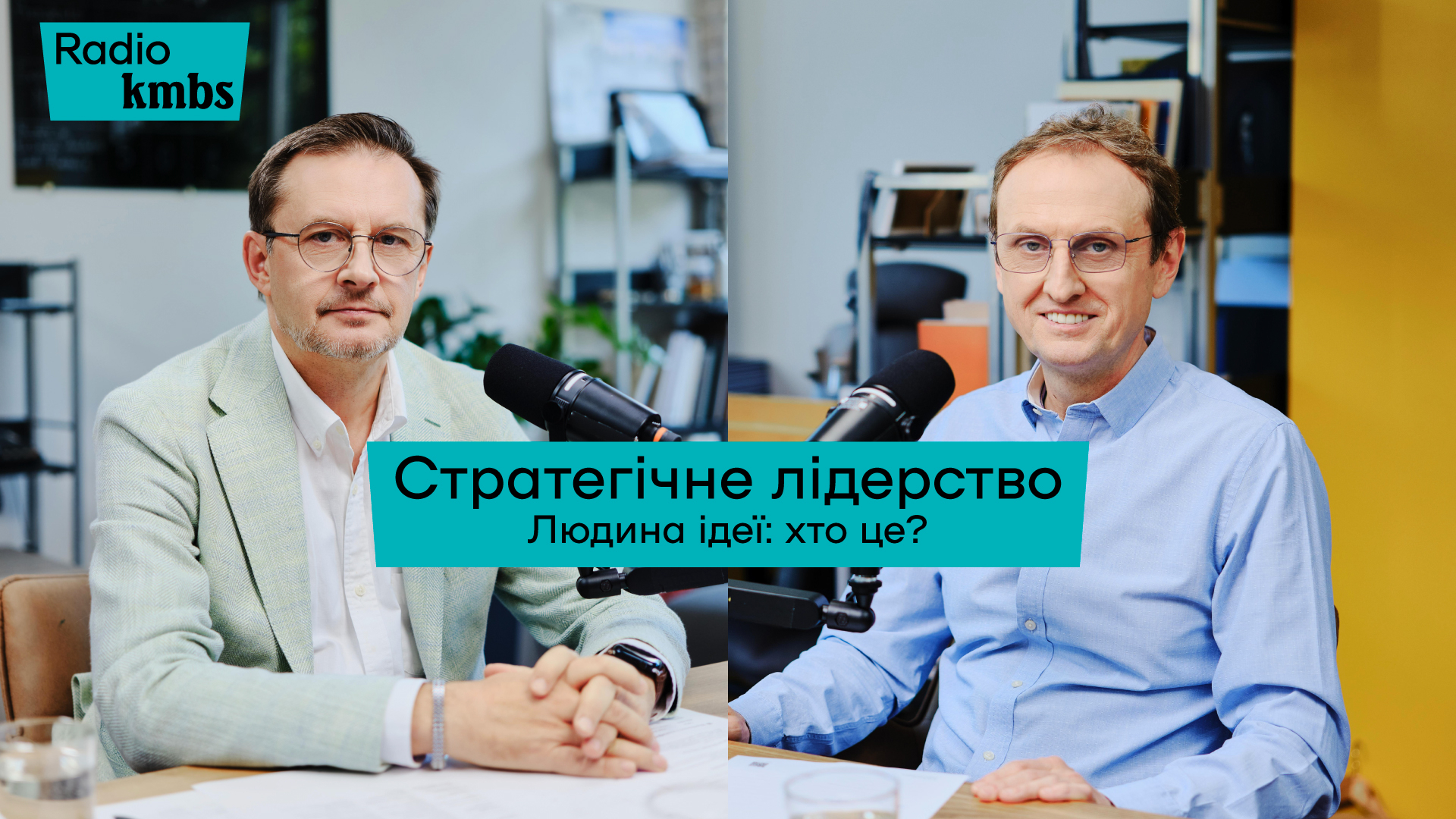
In a conversation with Maryna Starodubska, a lecturer at kmbs, an intellectual leader of the programs "Internal Communications and Corporate Culture: Strategic Level" and "Effective Communications: Reputation Management Practice," and the author of the book "How to Understand Ukrainians: A Cross-Cultural Perspective," we explore how personalized and formal approaches coexist in organizations, where the boundary of their effectiveness lies, and what changes in the organization when the focus shifts from heroes to systemic interaction.
Is the culture of “heroism” a historical norm for business, or is it rather a sign of an immature system?
At the beginning, business often looks like a "friendship gathering" — it's a startup or project where decisions are made quickly, and trust is based on personal connections. However, when a business needs to grow, it must transition from a "gathering" to a systemic state.
At this stage, our historical distrust of formal institutions often comes into play (~50% of Ukrainians believe that it is safest not to trust anyone, and more than 30% trust infrastructural state institutions such as the Government, the Verkhovna Rada, the judicial system, and the prosecutor's office). We do not trust institutions because, for several hundred years, they have mostly been punitive, unfriendly, and imperial towards Ukrainians. Thus, the perception that the system is an enemy, while a person is a friend, has formed. However, we usually only trust specific individuals from our close circle, but not the broader community. According to UNDP data, Ukrainians have the lowest indicators of horizontal cohesion when interacting with "others." Most citizens believe that if a problem arises, a formal institution is not the system that will help solve it. Therefore, managers often begin to impose a culture of “heroism” during the development stage of the organization, when it should already become a system. Because what is a system? It consists of elements organized according to a certain logic aiming for a specific outcome and interconnected — thus, a change in one element causes a change throughout the system. Formalized processes and rules are applied within the system equally for all — this provides transparency and fairness.
In practical management discourse, a culture of “heroism” means that employees should not only effectively perform their duties but also “live for work”: going to the office on weekends, taking calls during vacations, and responding to messages and emails at night. In Ukrainian business culture, this is expected by default: an effective employee not only completes all tasks on time, in full, and according to criteria. They go through discomfort and sacrifice something for the sake of work — be it leisure, time with loved ones, or hobbies. In contrast, the attitude towards processes is cautious — seen as “brakes” or “restrictions,” although well-organized processes eliminate transaction costs and accelerate work completion. The heroism culture is a result of Ukrainians' distrust of formal institutions and an exaggerated trust in people. Consequently, even large domestic companies are internally organized like a "ball of" informal chains because they do not actually function as systems.
Why does the "heroic" model often seem effective? Fast decisions, personalized responsibility. Why are such organizations fragile?
After an organization reaches a certain scale, the number of tasks that need to be completed increases exponentially. Accordingly, if delegation and control of execution are not regulated process-wise, it becomes necessary to renegotiate who does what and to whom they report each time. Or even worse — work is done "as it has historically happened," rather than in a more effective manner. If, at this moment, processes, indicators, and responsibility matrices are not established, those who personally agree on all decisions begin to drown in the number of these agreements. Consequently, the quality of decisions declines.
The number of decisions and tasks becomes such that leaders become "bottlenecks" in the system. They cannot keep up and often do not deal adequately with the quantity and content of the decisions being made because they lack specific knowledge and expertise.
If, however, processes, indicators, and the motivation system are documented and organized correctly, responsibility is delegated quickly, transparently, and effectively. Thus, the right system of motivation with sound processes simplifies management rather than complicating it.
At what point does a “strong leader” transform from a source of energy into a limitation for the system?
Not every leader evolves along with the organization. Allow me to provide a few public examples. Take the company Google. When Larry Page and Sergey Brin founded Google, they were young students. When Google “explosively” grew from a startup to a global corporation, Larry and Sergey realized that they lacked experience in managing such complex systems.
Therefore, they hired CEO Eric Schmidt, from whom they actively learned for about ten years. After the founders became ready to manage a company of that scale, Eric handed the control back to them. This is an interesting example where leaders recognized their limitations and made conscious efforts to evolve. They maintained productive professional relationships with the CEO even after his departure from the company.
Mark Zuckerberg, the founder of Facebook, took a similar path. When the company outgrew its startup phase and became a large corporation, he invited operational director Sheryl Sandberg to the team. She built the management structure and processes that ensured the company a mature corporate model.
The conclusion: A leader must either change along with the organization or strengthen it with professional management, inviting compatible people into these roles. Recognizing one’s own limitations of knowledge and experience is a sign of maturity, not weakness, in a leader.
Why is it that in the post-foundational stage, an organization either institutionalizes or begins to stagnate? How does the company, where sustainability is ensured by “heroes,” differ from one where it is ensured by processes?
Leaders must consciously move towards the systematization of the organizations they manage to strengthen and make them sustainable. One owner or leader cannot effectively manage all aspects of the system operations at the same time.
Sometimes, managers do not aim for institutionalization of systems but want to remain "absolute monarchs" in their organizations, so to speak. There are many reasons for this — but often it is the fear of losing status or control. It happens when a business owner hires an executive director and formally grants them authority. The following week, bypassing this director, they start assigning tasks to employees. When the executive director asks why this was not reported, the owner responds that they "have the right" because “it’s my company.”
In the “heroic” model, a person is a resource, in the process model — a bearer of a role, and in the mature model — a subject. How does this evolution change the way of thinking in the organization?
There is no scientific concept of a “mature” organization — if we are to be exact. There is a lifecycle stage called “maturity” in a range of systems for analyzing organizations and their cultures, but an organization can remain in an ineffective state of “a gathering of friends” led by a “monarch” for a long time before reaching maturity. In other words, what determines an organization’s maturity in its lifecycle does not always mean that it has a mature culture.
There is a whole range of scientific thought on the role of a person in the organization. When management was industrial, i.e., when the vast majority of businesses were manufacturing, the science of human resource management emerged. According to classical economic theory, an organization competes for customers in the markets for goods and services, and people (talents) are not the subject of competition. In such a system, people are a resource in the worst sense of the word; almost disposable material.
However, the science of human capital management demonstrates that the relationship between employers and employees is not economic but human. A person is the only asset of the organization that requires motivation at work. Technically, they cannot be a resource, because they can come to work and refuse to work. A resource does not require motivation as it can be used for its intended purpose imperatively (we don’t ask whether the printer paper wants to fit into the printer).
Gallup conducts an annual survey called “State of the Global Workplace Report,” which indicates that in Ukraine, the average level of employee engagement ranges between 20-25% (a figure before and during the war; before and after Covid-19). Engagement is the conscious and active performance of work using intellectual effort, emotional satisfaction from the result, and meaningful connections within the team.
The Gallup report indicates that it is not enough for people to have their needs met and their motivators triggered. A person must feel safe and also understand that they are being treated fairly. The perception of fairness is the most powerful factor influencing the quality of relations between an employee and an employer. This perception is based on four groups of parameters: whether responsibilities and rewards for results are distributed equitably between leaders and subordinates; whether the processes are transparent, logical, and effective; whether employees understand the logic of the decisions made; and whether leaders respect the employees in the work process. According to Gallup's research, unfair treatment of employees is among the top 5 reasons for burnout, while a destructive culture and issues with management are the number one reasons for resignations in Ukraine, according to EY Ukraine.
How does the evolution of the organization’s lifecycle change ways of thinking? Different focuses and challenges arise for leaders. However, from the perspective of working with people, the set of actions remains stable: address hygiene needs (finances, working conditions), trigger motivators (expertise, ambition, desire for development, recognition), and provide safety (respect, no toxicity and devaluation) to ensure they can be engaged at work.
What does an organization look like that has already undergone this transition? What feels different in it — for the leader, for the team, and for a new person?
Processes become simpler, more transparent, and clearer. Expectations crystallize, and every employee realizes what they need to do to achieve their goals (which are linked to the team's and organization's goals) and receive recognition. Decision-making becomes more transparent, quicker, and effective, and employees have greater opportunities for self-realization — instead of “putting out fires” or “fighting bureaucracy.”
There is an approach called the “Resource-Based View of the Firm.” It postulates that it is not enough to hire talented people because they can easily be demotivated by internal inefficiencies or poached away. An organization's sustainability arises when talented individuals are organized into motivated teams guided by transparent, logical, and effective processes within a constructive culture, creating stable and productive systems. Such results cannot be easily copied, and reproducing them takes time, creating a sustainable competitive advantage.